
European fire-bellied toad, Bombina bombina (Linnaeus, 1761)
The European fire-bellied toad (Bombina bombina) is a small tailless amphibian occurring mainly in the lowlands of Europe – from Denmark and eastern Germany in the west, to the Ural Mountains in the east, and from central Latvia and southern Sweden in the north, to Turkey in the south.
In areas where its range meets that of the yellow-bellied toad (Bombina variegata), it forms multi-generational interspecific hybrids and a so-called hybrid zone.

Species characteristics
The European fire-bellied toad is a small amphibian reaching up to 5 cm in body length. It is easy to identify due to the characteristic coloration of its ventral side. The belly is dark blue or black with bright, irregular spots that are relatively small and clearly separated from one another (this is a diagnostic feature distinguishing the European fire-bellied toad from the yellow-bellied toad). The spots are usually orange or reddish, rarely yellow. Interestingly, the arrangement of these spots is individual for each specimen, which allows for identification throughout the entire lifespan of the animal. When threatened, the toad sometimes adopts a characteristic defensive posture known as the unken reflex, exposing warning coloration on the limbs and throat (contrary to popular belief, it does not turn onto its back).
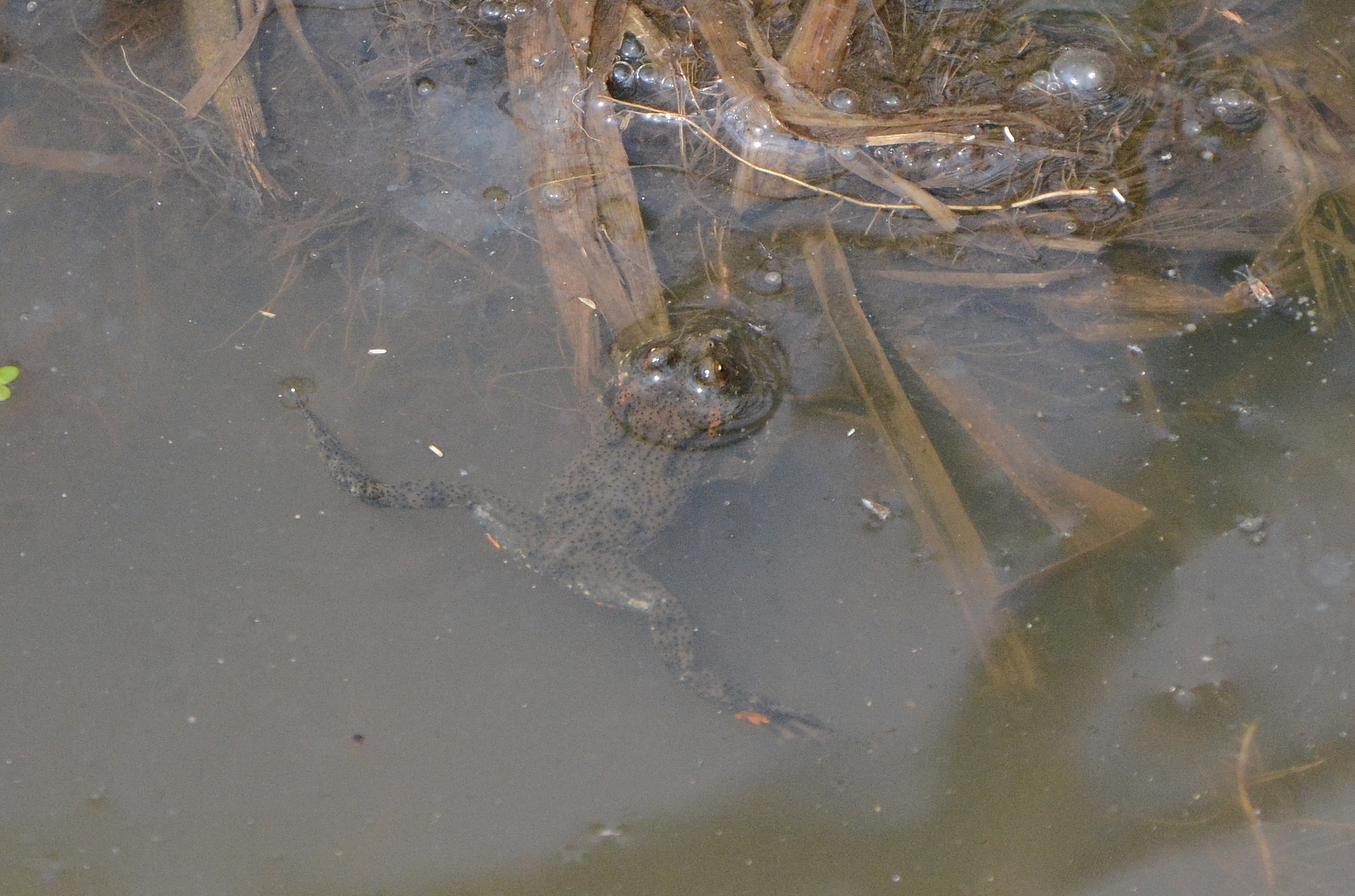
A characteristic feature of males is the presence of paired vocal sacs located beneath the skin of the floor of the mouth, which amplify mating calls. The calling behaviour itself is also distinctive – the male uses air stored in the lungs, causing the body to increase significantly in volume, giving the animal the appearance of a flattened balloon floating on the water surface.
It is strongly associated with aquatic habitats, which it leaves only in search of food or in autumn, when it looks for suitable hibernation sites. The species breeds in shallow, sunlit water bodies such as oxbow lakes, drainage ditches and temporary floodplains.
In Poland, the European fire-bellied toad is under strict species protection and is considered threatened due to the loss of suitable habitats.